
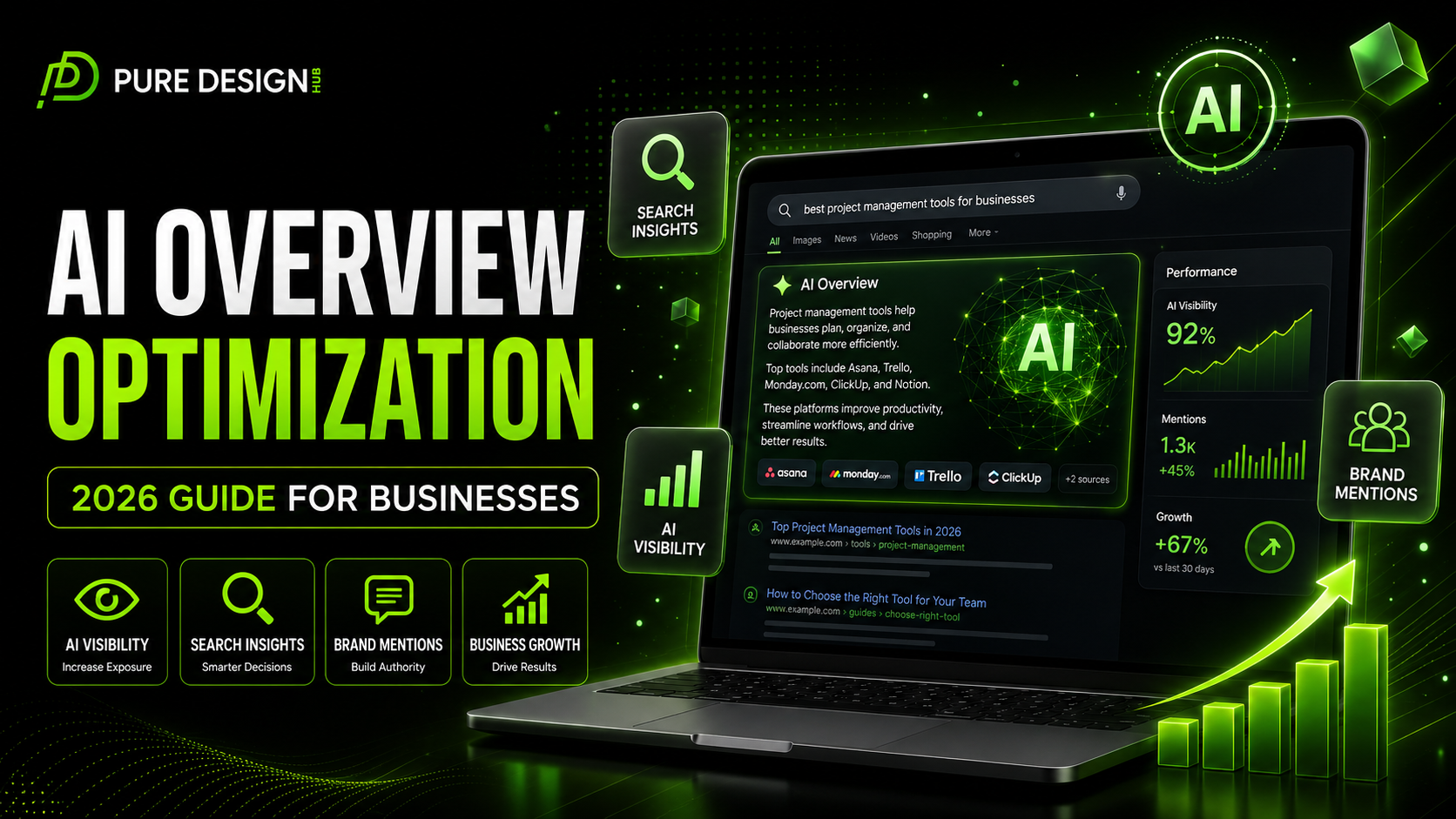



Google Search is changing quickly. AI Overviews and AI Mode can answer complex questions directly in search while showing links to supporting websites. For businesses, that creates a new visibility challenge: ranking in traditional results still matters, but pages also need to be clear and useful enough to support AI-generated answers.
AI overview optimization is the process of improving a website so its pages are easier for Google to crawl, understand, rank, and use as supporting sources in AI-powered Search. It is not a replacement for SEO. Google says the same core SEO practices remain relevant to AI Overviews and AI Mode, and there is no special AI schema required.
What Is AI Overview Optimization?
AI Overview optimization makes web content useful for people and Google’s search systems. A strong page answers the searcher’s question clearly, adds original value, is technically accessible, and connects related ideas in a logical structure.
Google explains that its generative search features use information from the Search index. A page still needs to be crawlable, indexed, and eligible to appear with a search snippet before it can be considered as a supporting link in AI features.
That is why AI search optimization starts with normal SEO fundamentals. Helpful content, clear internal links, good page experience, accurate business information, and sound technical foundations all support visibility.
Why AI Visibility Matters for Businesses in 2026
AI-powered search changes how users discover companies. A person may ask, “What type of website is best for a local service business that wants more leads?” Google can answer the question, compare options, and surface supporting sources in the same experience.
A business can earn visits through AI-generated answers and improve AI brand mentions when its online presence clearly explains what the company does and who it serves.
Google reported in May 2026 that AI Mode had passed one billion monthly users, with queries more than doubling each quarter since launch. That growth makes AI search visibility a practical marketing issue rather than a passing SEO trend.
Traditional SEO vs AI Overview Optimization
Traditional SEO and AI Overview optimization work together. The main difference is how content may be discovered and presented.
| Area | Traditional SEO | AI Overview Optimization |
|---|---|---|
| Main goal | Rank pages in organic results | Improve usefulness as a source in AI-powered Search |
| Search behavior | Often shorter keyword searches | Often detailed, conversational questions |
| Content focus | Match search intent | Answer the main query and related questions clearly |
| Technical foundation | Crawlability, indexing, speed, mobile usability | The same SEO foundation remains necessary |
| Content value | Helpful, original information | Helpful, original information that can support an AI answer |
| Measurement | Clicks, impressions, CTR, rankings, conversions | Traditional metrics plus generative-AI visibility where available |
Businesses do not need to choose between SEO and AI optimization. Google says its generative AI features are rooted in Search ranking and quality systems.
How to Optimize for Google AI Overviews
1. Answer the Main Question Early
Do not make readers search through several paragraphs for an answer. Introduce the topic clearly, then explain the details.
If a section asks, “What is AI Overview optimization?” the first sentence should define it. Direct answers make content easier for readers to scan and keep each section focused on a clear search intent.
2. Create Original, Non-Commodity Content
Repeating what competing pages already say gives Google little reason to prefer your page.
Add something specific: first-hand experience, a practical process, an expert observation, original examples, or data from your own work. Google’s 2026 guidance recommends valuable, unique, non-commodity content instead of pages that simply rewrite information already available online.
For Pure Design Hub, that could include observations from real SEO audits, website projects, or Search Console performance patterns without exposing client information.
3. Cover Related Questions Without Losing Focus
A page about AI overview optimization should stay focused, but it should answer the next questions a business owner is likely to ask.
Useful supporting sections can explain whether traditional SEO still matters, how businesses can improve AI visibility, and how performance can be measured. Strong topic coverage is useful; keyword stuffing is not.
Each section should solve a distinct problem while remaining connected to the main topic.
4. Keep Important Information in Visible Text
Google advises site owners to keep important content available in textual form. Images, videos, and charts can improve the page, but important information should not exist only inside graphics.
If you publish a chart showing a performance gain, state the figure in nearby text. If you add a comparison, use a real HTML table rather than an image of a table.
This also makes important information easier for users to scan and understand.
5. Strengthen Technical SEO
A page cannot gain useful search visibility if Google cannot access or index it properly.
Check robots.txt rules, canonical tags, internal links, status codes, mobile usability, page speed, JavaScript rendering, sitemap inclusion, and index status. Structured data should match the visible content.
Businesses using professional web development services in USA should make sure developers and SEO specialists follow the same technical requirements. A good-looking website can still underperform if important content is difficult to crawl or render.
6. Build Clear Internal Links
Internal links help users and search engines understand how pages relate to each other.
Link naturally to supporting resources about technical SEO, SEO content, search intent, mobile SEO, and structured data. Use descriptive anchor text instead of generic phrases such as “click here.”
For example, a discussion about crawlability can point users toward a technical SEO checklist. A paragraph about creating useful content can link to a detailed SEO content guide.
This approach strengthens the relationship between related pages without forcing every keyword into one article.
7. Strengthen Expertise and Business Trust
Make it easy to identify who created the content and which organization is responsible for it.
Use an accurate author name, useful author bio, About page, clear contact information, and consistent company details.
Do not manufacture reviews, mentions, or citations. Google focuses on helpful, reliable content and warns against producing large amounts of low-value content primarily to manipulate rankings.
Real experience gives readers something they cannot get from another generic article.
8. Write for Customers, Not Just Keywords
Keywords help define the topic, but awkward repetition hurts readability.
Use AI visibility, AI search optimization, and AI brand mentions where they naturally fit. Then write in the language a business owner would actually use when asking a question.
The same rule applies to commercial phrases. SEO services in USA are relevant when discussing professional help with technical, content, and search strategy.
Professional content writing services in USA also fit when discussing expert-led content creation. These terms should support the article rather than change its main search intent.
The primary topic must remain AI Overview optimization.
How Should Businesses Measure AI Search Performance?
Start with Search Console metrics such as impressions, clicks, queries, landing pages, CTR, and average position. Then monitor Google’s generative-AI performance reporting if it is available for the website.
Google introduced dedicated Search Console reporting for generative AI visibility in June 2026, initially rolling it out to a subset of websites. The reports are designed to provide visibility data connected with generative features such as AI Overviews and AI Mode.
Also track qualified leads, form submissions, calls, branded searches, assisted conversions, and referral traffic. More impressions have little value if they do not support customer acquisition.
For a service business, this distinction matters. Traffic is useful, but traffic from people actively researching a solution has greater commercial value.
Common AI Overview Optimization Mistakes
The biggest mistake is treating AI search as a loophole.
There is no special “AI Overview schema” that guarantees inclusion. Thin FAQ pages, large volumes of rewritten content, unnecessary AI-specific text files, or repeated keywords will not create durable visibility. Google specifically says no additional special markup is required for AI Overviews or AI Mode.
Another mistake is ignoring traditional SEO. AI-powered Search still depends on Google’s broader Search systems, so indexing, content quality, internal linking, and technical performance remain central.
Avoid generic content with no evidence of experience. If every paragraph could belong to any agency website, the page has little reason to stand out.
AI Overview Optimization Checklist
Before publishing, confirm that the page:
- answers its main question near the top;
- targets one clear search intent;
- adds original information or expert context;
- uses descriptive headings;
- includes relevant internal links;
- keeps important information in visible text;
- uses a real table for comparisons;
- loads well on mobile devices;
- has correct canonical and index settings;
- uses structured data only when it matches visible content;
- includes clear authorship and business information;
- avoids unnecessary keyword repetition.
For a service business, the next step might be an SEO consultation or AI visibility review. The CTA should match the problem discussed in the article rather than interrupting the reader with a generic sales pitch.
Is AI Overview Optimization Worth It for U.S. Businesses?
Yes, especially for businesses that depend on organic discovery or customers who research services online. AI search does not remove the need for SEO. It adds another way strong pages can be discovered.
Improve the website in ways that support traditional rankings, AI Overviews, and AI Mode. Focus on technical clarity, original content, trustworthy information, and real customer questions.
Companies that start improving those foundations now will also be better prepared as search behavior continues to change.
FAQ’s
AI Overview optimization improves a website’s content and SEO foundations so its pages are more useful and eligible to appear as supporting sources in Google’s AI-powered Search experiences.
There is no guaranteed AI Overview ranking method. Build crawlable, indexed pages with original, helpful content, clear answers, strong internal links, and sound SEO fundamentals.
No. Google says there is no special schema or additional markup required to appear in AI Overviews or AI Mode.
AI search optimization is an extension of SEO, not a replacement. Google says its generative AI Search features rely on core Search ranking and quality systems.
Improve AI visibility by publishing useful original content, fixing technical SEO issues, strengthening internal links, keeping business information accurate, and measuring performance in Search Console.
One Response