

Getting traffic from Google is not only about publishing more content. It is about publishing the right content and making every page easy for both users and search engines to understand. That is where on page SEO becomes important.
On page SEO is the process of improving the visible and technical parts of a webpage, including the title, headings, content, images, internal links, URL, schema, and user experience. Google also explains SEO as a way to help search engines understand your content and help users decide whether they should visit your site through search results.
In 2026, this matters even more because Google is no longer just matching exact keywords. It is trying to understand meaning, search intent, content quality, page experience, and trust. If your page is not properly optimized, even good content can stay stuck on page three or four.
Why On Page SEO Still Matters in 2026
Many business owners think SEO means backlinks only. Backlinks matter, but if your page is weak, unclear, slow, or badly structured, backlinks alone will not fix everything.
On page SEO helps Google understand three important things:
What your page is about
Who the page is for
Why your content deserves to rank
Organic search is still one of the strongest traffic channels. BrightEdge research has shown that organic search remains a major source of trackable website traffic, with organic search reported at 53.3 percent of traffic in its channel share research.
This is why businesses cannot ignore on page SEO. A well optimized page can bring free traffic for months or even years, while paid ads stop the moment the budget ends.
Another important point is click through rate. Backlinko’s 2025 Google CTR study found that the number one organic result gets an average CTR of 27.6 percent, and the first result is far more likely to get clicks than lower positions. This means moving from page three to page one can completely change your traffic.
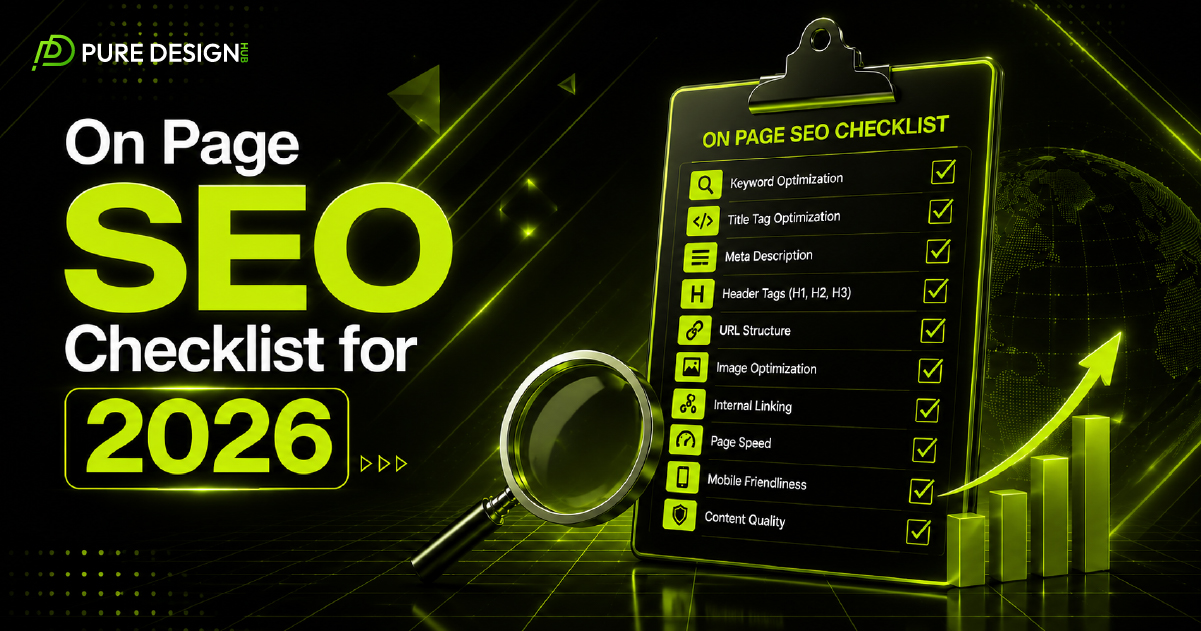
Complete On Page SEO Checklist for 2026
1. Start With the Right Keyword
Before writing any page, choose one main keyword. This keyword should match your service, audience, and search intent.
For example, if you are writing for a digital agency, a broad keyword like “SEO” is too difficult. A better keyword would be:
“on page SEO checklist”
“SEO checklist for small business”
“how to optimize a page for SEO”
These keywords are more specific and easier to target. They also show clear intent.
A good keyword should have three qualities:
People are searching for it
It matches your service or topic
You can create better content than existing results
Do not choose keywords only because they have high volume. Choose keywords that can bring the right visitors.
2. Match the Search Intent
Search intent means the reason behind a search. If someone searches “what is on page SEO,” they want a simple explanation. If someone searches “on page SEO checklist,” they want a practical list they can follow.
This is where many websites fail. They target the keyword but ignore the intent.
Before writing, check the first page of Google. Look at what is ranking. Are the top results guides, checklists, service pages, tools, or comparison articles? Your content should match that format while adding something better.
For this topic, the search intent is informational with some commercial value. The reader wants to learn, but they may also need SEO services if they cannot handle it alone.
3. Write a Strong SEO Title
Your SEO title is one of the first things users see in Google. It should include the main keyword and give people a reason to click.
A weak title is:
“On Page SEO”
A better title is:
“On Page SEO Checklist for 2026: How to Optimize Every Page for Better Rankings”
This title works because it is clear, updated, keyword focused, and benefit driven.
Keep your title natural. Do not repeat keywords too many times. Google and users both prefer clear titles.
4. Create a Helpful Meta Description
Your meta description does not directly guarantee ranking, but it can improve clicks when written well.
A good meta description for this blog could be:
“Follow this on page SEO checklist for 2026 to optimize titles, headings, content, images, links, schema, and user experience for better rankings.”
It tells the reader exactly what they will get. That is better than a vague description full of keywords.
5. Use One Clear H1
Every page should have one main H1. The H1 should describe the page clearly.
For example:
“On Page SEO Checklist for 2026: How to Optimize Every Page for Better Rankings”
Your H1 should not be too clever or confusing. It should help readers and search engines understand the page topic within seconds.
6. Use H2 and H3 Headings Properly
Headings make your content easier to read. They also help Google understand the structure of your page.
Use H2 headings for main sections and H3 headings for smaller points inside those sections.
For example:
H2: Complete On Page SEO Checklist
H3: Optimize Your Title
H3: Add Internal Links
H3: Improve Image Alt Text
Do not use headings only for design. Use them to organize meaning.
7. Optimize the First 100 Words
The opening section of your page should clearly mention the main topic. Readers should not have to scroll too much to understand what the page is about.
Include your main keyword naturally in the first paragraph. Also explain the benefit of reading the page.
Avoid long, slow introductions. Get to the point quickly.
8. Use Keywords Naturally
Keyword stuffing does not work. It makes content look spammy and uncomfortable to read.
Instead of repeating the same keyword again and again, use related terms naturally. For this blog, related keywords can include:
SEO checklist
page optimization
search intent
meta title
internal linking
image SEO
schema markup
content optimization
This helps Google understand the full topic without making your content sound robotic.
Semrush explains that modern ranking analysis includes relevance, content quality, readability, backlinks, and on page elements, which means pages need more than exact keyword usage to perform well.
9. Add Internal Links
Internal links are very important for your website. They help users move from one page to another, and they help Google discover and understand related pages.
For Pure Design Hub, this blog should link to:
Keyword Research blog
Search Intent blog
SEO Content blog
Mobile SEO blog
Rich Snippets blog
SEO Cost blog
SEO Services page
Use natural anchor text. For example, instead of writing “click here,” write “keyword research for SEO” or “SEO content strategy.”
A strong internal linking system can help your SEO cluster grow faster.
10. Optimize Images and Alt Text
Images make your content more engaging, but they should be optimized.
Use compressed images so your page loads fast. Rename image files properly before uploading. Instead of “IMG1234.jpg,” use “on page seo checklist.jpg.”
Alt text should describe the image naturally. Do not stuff keywords.
Good alt text:
“On page SEO checklist showing title, headings, links, and image optimization”
Bad alt text:
“on page SEO checklist best SEO checklist SEO services USA”
Google wants useful descriptions, not keyword spam.
11. Add Schema Markup
Schema markup helps search engines understand your page better. Google says structured data can help it understand page content and may be used for rich results when eligible.
For a blog post, you can use:
Article schema
Breadcrumb schema
FAQ schema where useful
Organization schema for the website
If your website uses WordPress, plugins like Rank Math or Yoast can help automate this. If your site is custom built, schema can be added through JSON LD code.
12. Improve Mobile Experience
Mobile SEO is not optional anymore. Most users search from mobile devices, so your page should be fast, clean, and easy to read on small screens.
Check these things:
Text size is readable
Buttons are easy to tap
Images fit the screen
Page loads quickly
Popups do not block content
Navigation is simple
A page can have great content, but if users leave because the mobile experience is poor, rankings may suffer.
13. Add a Clear CTA
Every blog should guide the reader toward the next step.
For example:
“Need help improving your website rankings? Pure Design Hub can help you create SEO optimized pages that attract traffic and turn visitors into leads.”
A CTA should feel natural. Do not push too hard, but do not leave users with no direction.
Common On Page SEO Mistakes
Many websites struggle because they repeat the same mistakes.
They target the wrong keyword.
They ignore search intent.
They use weak titles.
They publish thin content.
They forget internal links.
They do not optimize images.
They skip schema.
They write for Google only and forget real readers.
The best SEO content helps users first. Google’s helpful content guidance also focuses on creating content for people, not just search engines.
Final Thoughts
On page SEO is one of the easiest ways to improve your website’s ranking potential. You do not always need to publish more pages. Sometimes, you need to improve the pages you already have.
In 2026, the best ranking pages will not be the ones with the most keywords. They will be the pages that answer the user clearly, match search intent, load fast, use proper structure, and connect naturally with other useful pages.
If you want better rankings, start with this checklist. Choose the right keyword, write for the right intent, improve your headings, add internal links, optimize images, use schema, and make the page easy to read.
That is how you create pages that Google can understand and users actually want to read.
FAQ’s
On page SEO is the process of optimizing individual web pages to improve rankings in search engines. It includes content, keywords, headings, internal links, and meta tags for better visibility.
Key factors include high-quality content, keyword placement, title tags, meta descriptions, internal linking, mobile optimization, page speed, and user experience. Google now prioritizes helpful, intent-based content.
Improve on page SEO by optimizing content for search intent, using proper headings, adding internal links, optimizing images, improving speed, and regularly updating content for better rankings and traffic.
4 Responses